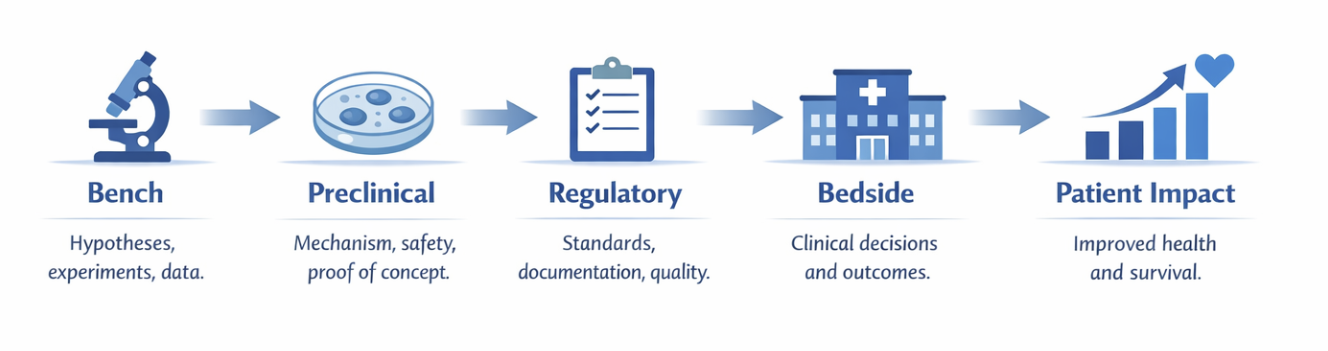
My path to research began with a desire to understand why—why systems behave the way they do, why interventions work in some cases and fail in others, and how knowledge can be translated into outcomes for patients and communities.
I was first drawn to medicine through hands-on clinical work in veterinary settings. Working across general practice, emergency, and equine clinics showed me medicine at its most immediate: diagnostic reasoning, rapid decision-making, and clear communication that can change outcomes. In emergency settings, focus becomes singular— identify the problem, act decisively, and protect a life.
Over time, those clinical experiences raised deeper questions. I began noticing patterns—especially the growing presence of antibiotic-resistant infections. I could treat the individual case in front of me, but I wanted to understand the forces driving these trends at a broader level. That curiosity is what led me to research.
At the University of Michigan, I joined an academic lab early in my undergraduate career, working on projects spanning disease ecology, epidemiology, climate change, and virulence. Research taught me rigor: how to design experiments carefully, analyze data critically, and communicate findings clearly. I came to appreciate that reliability is built on disciplined methodology and reproducibility.
My interests increasingly focused on antibiotic resistance through a One Health lens—how human activity, environmental context, and biological systems intersect. This culminated in my honors thesis, analyzing resistance patterns across urban, agricultural, and natural environments to understand how different contexts shape microbial resistance. I presented this work at multiple research symposia and further developed it at the University of Wisconsin, strengthening both my technical skill set and commitment to translational science.
Studying abroad at the University of Sussex added another dimension: animal behavior research reinforced systems thinking—biology does not exist in isolation, but is shaped by environment, behavior, and context.
Alongside research, my exposure to the regulatory side of medicine—supporting a medical malpractice practice— added critical context. I saw how standards of care, documentation, and accountability shape clinical decisions and patient outcomes. It reinforced that scientific innovation must operate within robust regulatory and ethical frameworks to truly serve patients.
Today, my work in biotech brings these threads together. At Umoja Biopharma, I see how discovery, rigor, regulation, and execution converge to translate science into real therapies. Working in translational immunotherapy—reprogramming T cells in vivo to target cancer—has shown me how research moves beyond the bench into structured development pipelines designed for scale and impact.
I chose research because it lets me look beyond a single moment and focus on durable solutions—where curiosity becomes evidence, evidence becomes innovation, and innovation becomes care.